Showing posts with label Aspiran. Show all posts

Wednesday, 13 October 2010

Location Location Location

Before we'd ever heard of Aspiran we spent a week in a small Hamlet near Olargues in the Haut Languedoc. The views across and along the valley of chêne vert forested hills were spectacular and the 1000m plus high Espinouse could be walked up from the back door. Pretty idyllic, but the modest remoteness had drawbacks. The boulangerie was a 20 minute round trip. It took 5 minutes to reach the main east-west valley road and the options were turn left or right. The supermarket was nearly half an hour away. Going north to nowhere, or south to Beziers, involved seriously scenic but narrow winding roads.

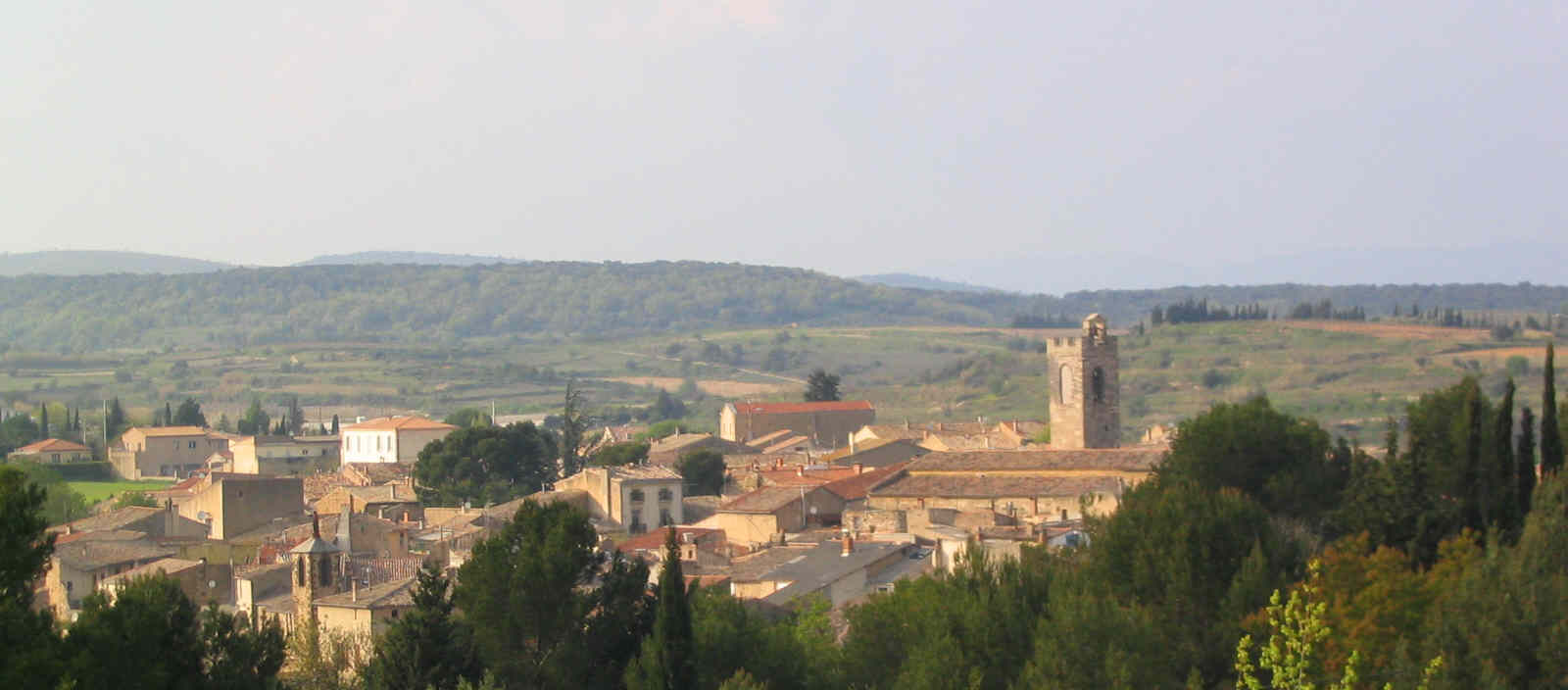
By complete contrast, Aspiran sits it rolling foothills nicely between Clermont l'Herault and Pézenas. Montpellier's tramway is just over half an hours drive away, as is central Béziers.


Five roads leave the village and seven neighbouring villages are reached directly without passing through others. An eighth, Belarga, counts when the Herault is low enough to walk over the weir. The A75 (Clermont Ferrand via Millau to Beziers autoroute) skirts the commune but is well away from the village and ensures the RN9 is a quiet local road. There are oak woods, a pine tree wood, garrigue and, of course, vines. Along with a baker are a few other commerces, tabac, post office, pharmacy and two bars. Supermarkets and brico sheds at Clermont are 10 minutes away.

Overall a pretty ideal compromise between open spaces, scenery, services and access to the department's facilities.

Monday, 5 July 2010

Medieval music in the streets


Flyers for this were well hidden, we spotted one in the baker that stated Sunday evening 21h for a tour of the medieval village with music by the group "Sabor". A small crowd gathered at the Place du Peyrou and soon a delay was announced due to storms in Montpellier. Over half and hour later there was the sound of distant thunder that soon became louder, but also took on a distinct beat. "Sabor" turned out to be a medieval band (flutes, horns, drums) who had marched up the Grand Rue in full pomp accompanied by torch bearers.


After the band's opening number a guide and local history expert from Pézenas introduced the village - fortunately he has a clear loud voice. What followed was nearly two hours of parading through streets (and at one stage the river bed) to music with pauses for dancing and, while the musicians gathered their breath, more discourse on historic sites - la Placette, Chapelle des Pénitents, ramparts, river Garelle, Chemin de sous Ville and Portes.

Quite an evening and clearly scheduled to be the first Sunday of the school summer holidays. It's also good to see people have such a good time without alcohol. Apparently this isn't an annual event, but maybe it will be.

Friday, 25 June 2010

What's in a name

How did Aspiran get its name? In the village library I borrowed a short booklet "Travers le Temps" which consists of notes made from the work of local historian François Bonnéry. It was published back in 1995 by the village projects group "L’Amical Laïque d’Aspiran".

The 2nd to 5th century AD was the Gallo-Roman period which finally broke down with barbarian invasions dawning the so called dark ages. The centre of village as we know it today didn't really exist, the area would have been a collection of small holdings sited where water was available. During that time one of the village inhabitants was called either ASPER or SPIRIUS and he had a small holding by the Croix du Coq (cross of the cockerel). This exists today and is by the raised junction on the way out of the village 100m past the cave coopérative - rather sadly next to recycling bins and wedged between a lamppost and give-way sign. At one time the river Garelle forded the road here, today it flows underneath.

The Latin suffix “ANUM” indicates ownership and this resulted in the name “ASPIRANUM” or “SPIRANUM”. As the “UM” is nearly silent this presumably evolved at some stage to “SPIRIAN”. The Occitan name for the village is “ESPIAN” – apparently in Occitan the “r” between the vowels is suppressed which supports the name being derived from “ESPIRAN”. In French it is of course “ASPIRAN”.

Tuesday, 5 May 2009

Oldest Winery in France - at Aspiran

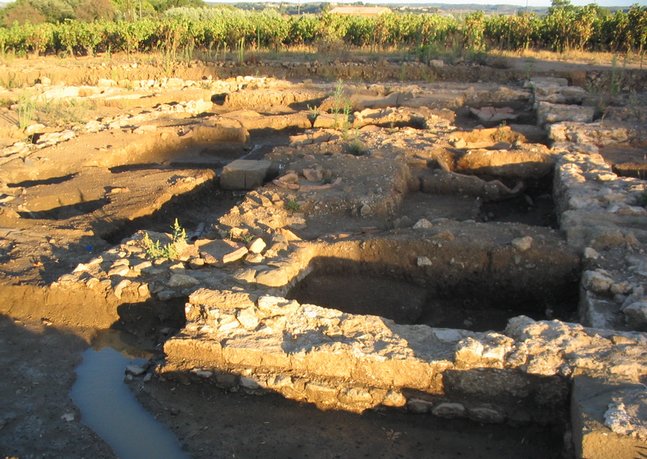
As you go north on the main N9 road from Aspiran to Nebian and Clermont l'Herault you pass over the river Dourbie. To the left, just before the trees and bridge is the archaeological site of the oldest winery discovered in France.

The winery dates from the 10th year AD, the time of Emperor Augustus. The owner was the Roman Quintus Julius Primus - his name has been found inscribed on pottery made in kilns on the site.

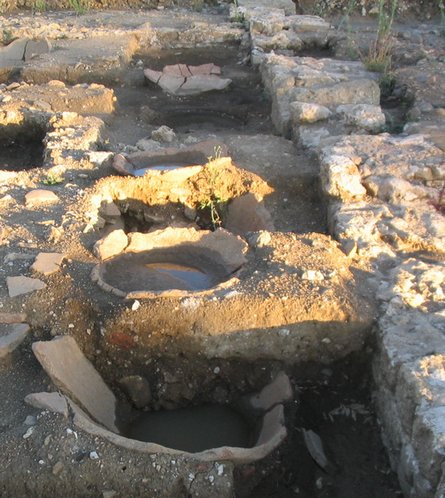
The pictures show where enormous Dolias pots with a capacity of over 1200 liters were buried in the ground. The winery was sophisticated - water circulated around the Dolias to keep the wine cool, much like modern stainless steel tank systems.
The building included luxuaries such as a large indoor pool, toilets and piped fresh water.
Below his is the site of the pottery where the Dolias along with the smaller amphora (used to transport the wine) were made. The site is on the route to the north from Agde and the Via Domitia - the Roman coast road from Italy to Spain. Two amphora have been found in Rome inscribed "I am a white wine from Beziers" and suggest that wine was sent to Rome from here.
The archaeologists, from the CNRS (Centre National de la Recherche Scientifique), have been staying at the old Aspiran school. Here a team is excavating an area that included a bakery, kitchen and supply store.

Friday, 3 April 2009

Aspiran buildings and ramparts

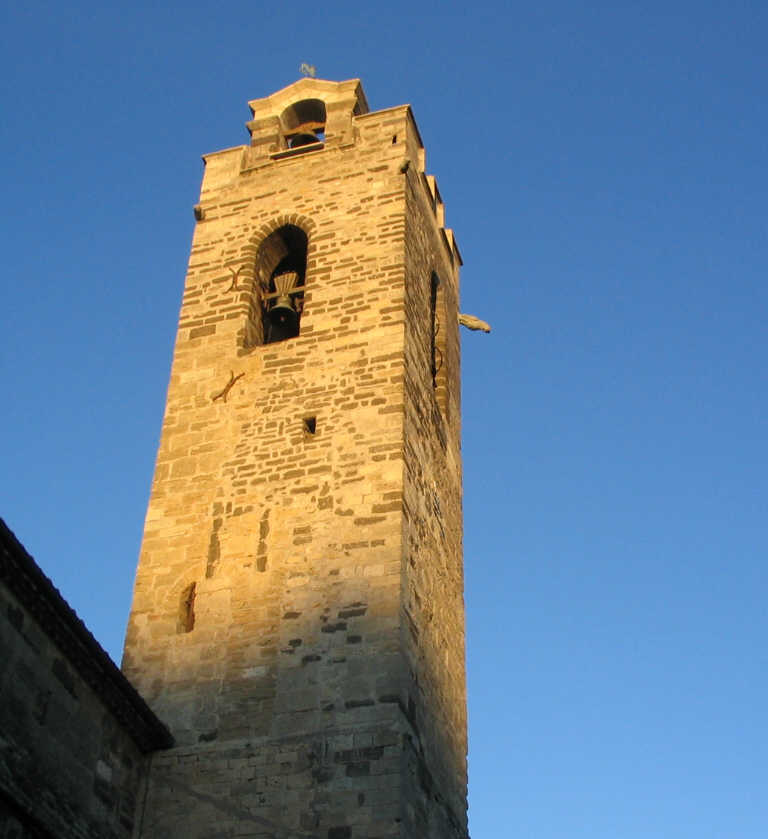
The 13th century bell tower of the Church St Julien at sunrise. The current church on this site dates from 1145 although the bell tower is built on Romanesque remains.
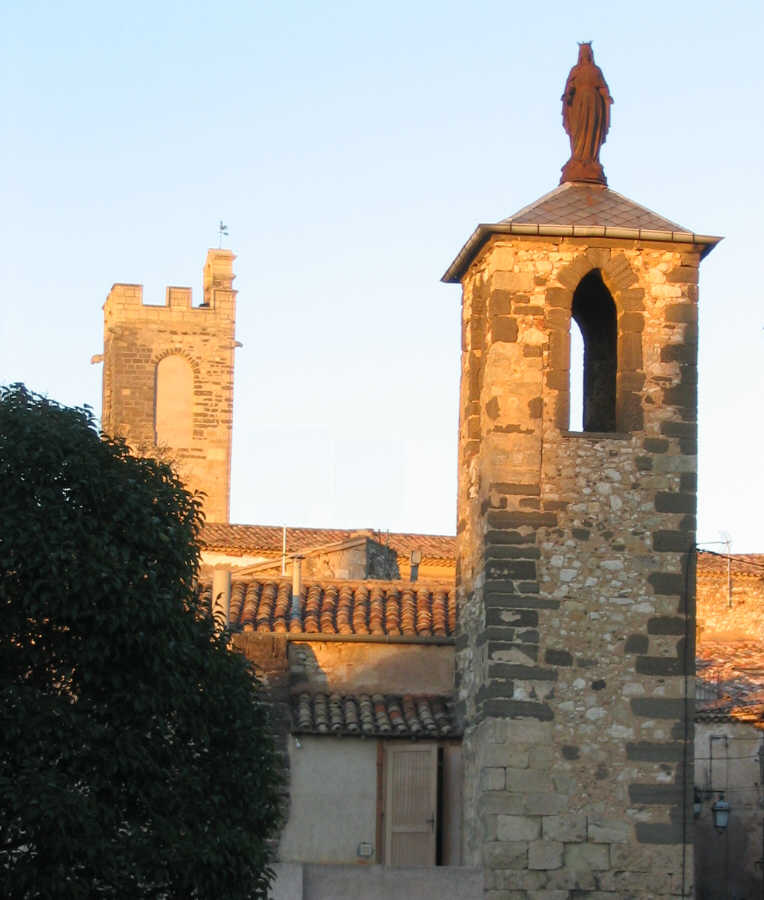
The Chapel of Pénitents with the church tower behind. The inside is now a beautifully restored hall and exhibition space. The bell tower was built in 1816.
The ramparts date from the 12th century and still enclose much of the village with the old walls forming parts of many houses. At one time Aspiran had four portes (entrances) but only these two remain.

Sunday, 1 March 2009

Introduction

Aspiran is a wine village with a population of around 1250 on the western edge of the Hérault valley between Clermont l'Hérault and Pézenas.


There has been a settlement here since at least Roman times. Archaeologists have been excavating the site of France's oldest known winery dating from the 10th year AC.
Today Aspiran sits in a sea of vines along with olive, pine and oak trees.