Friday, 21 May 2010

Railway remains

During the 1800s the Hérault was criss-crossed by the construction of a surprising number of railway lines. Aspiran was on a branch connecting Lodeve down to Beziers and Agde where the main coastal line still runs today. The stretch from the cost to Clermont l'Herault opened on 1858 and passed through the commune following a route next to that taken by the RN9 north from Paulhan today.


A couple of kilometres down the hill from the village is Aspiran Gare, a hamlet between the RN9 and the Hérault river. This picture is the remains of the station buildings, the line ran from near left to far right.


This remote section is where the line crossed the ravine of the Dourbie on its way to Clermont l'Herault. The viaduct is certainly the most pronounced rail legacy in the commune although vegetation precludes an interesting picture of the arch underneath. Its also just a stones throw from the the A75 autoroute opened in 2002.


At Paulhan the remains of the station and junction are still in strong evidence - this section going south was only closed in 1991. This is where the east-west line from Bédarieux and beyond to Montpellier crossed the Aspiran line. Further down, just past Lézignan-la-Cèbe, is a short branch to a quarry. Trains operated from here to the main line at Vias until the mid-2000s and will be restarting to provide stone for building the TGV line extension from Nîmes to Montpellier,

For more information seek out Chris Elliott's self published book The lost railway lines of l'Hérault, the text is in French and English. Chris can be contacted at christopher.elliott at club-intrnet.fr (email disguised to reduce spam)

Monday, 19 April 2010

Nesting Kestrels

A pair of Kestrels (Faucon crécerelle, Falco tinnunculus) have taken up residence in Aspiran and appear to be eyeing up a nest site through a gap high up on the village church wall.

As originally and incorrectly posted here, these are not the rare Lesser Kestrels that have colonised the nearby village St Pons-de-Mauchiens.


One would hardly know of their presence if it wasn't for the frantic screeching (chai-chai-chai) that seems to be part of their bonding behaviour. While most of the time they're presumably away hunting they court and preen on this TV aerial, especially early morning and evening.


The pair seem quite young from the plumage and size - I estimate them to be around 24 cm head to tail given the width of this drain pipe is 11 cm.

Monday, 28 September 2009

Farm Bio Lous Selces

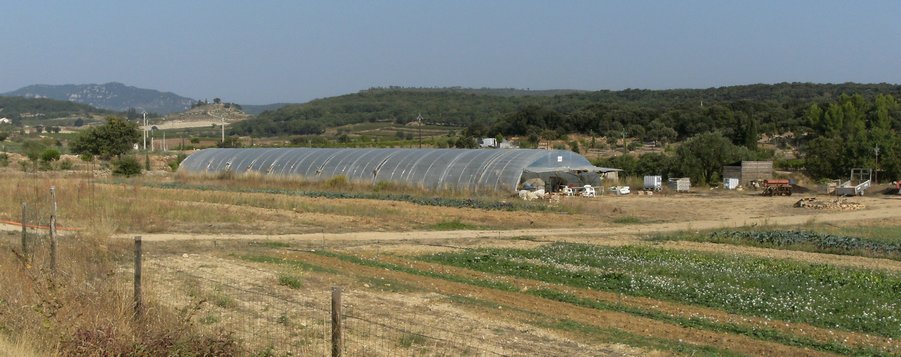
Going north up the hill from Aspiran towards Lieuran-Cabrières the road flattens out after 1.5 Km and to the right la ferme bio Lous Selces comes into view; the long polytunnel gives it away. The setting may look idyllic with views for miles around, but this must be the windiest place in the commune and natural shade is non-existent. The ground here is limestone – seashell fossils can be spotted everywhere in the rocks and soil. It needed compost, actually sourced from local recycled biodegradable waste, to make it fertile. An overriding reason for the location is the spring after which the farm is named, Lous Selces is Occitan and means the willow trees.

2007 was the first season for Roselène and Sirik Andringa who live on the spot with their two young boys, two dogs, several cats, occasional sheep and guinea fowl plus over 100 laying hens. Produce is seasonal – radishes, young garlic, lettuces, carrots, courgettes, aubergines, cucumbers, endless varieties of tomatoes, beans, peas, new potatoes to name a few. As well as the elements to battle crops are frequently attacked by moles, mice and rabbits.

You can buy produce late afternoon on Wednesdays and Fridays. Sirik also runs a stall at the Pezanas Marché Bio Saturday mornings.

Sunday, 13 September 2009

Figs

The best wild fruit to be found around Aspiran is figs. They beat mulberries for diversity and speed of picking. Sadly apricots et al don’t seem to grow wild here. Quinces are insect riddled and pomegranates seriously seedy.

There are quite a few fig trees about, although many seemingly produce nothing or fruit that rots before it ripens. Edible figs are around from July to October and these six varieties were found on lane side trees within 3 Kms of the village in mid-September. Despite a book on figs and of course Internet searches, identifying species from pictures is challenging as appearance depends on the degree of ripeness; all figs start off a soft green colour. A visit to an arboretum of fig trees down the road at Nézignan-l'Évêque last year raised more doubts than answers on identification.

The bounty

The green ochre specimins on the top right could well be the Marseillaise variety and they’re delicious but prone to fermenting quickly when ripe (hours not days) so don't keep. The large ones on the bottom left match Madeleine des Deux Saisons characteristics because of their size and unbeatable sweet succulent eating. The grey cinder coloured figs top-centre look like photos of Grise de Saint-Jean and are also amazingly sweet. The central lime-green ones are harder to identify but I'll go for Sucre Vert as the trees are large and incredibly productive. They're also the last to ripen and go on producing the latest. With a slightly less sweet taste plus the quantity to be had they make fine jam.

The deep purple ones at the front could be one of several varieties, while the marble sized pile to their right are probably from a particularly water stressed tree. Either way, these noir varieties dry without fermenting making concentrated sweets to keep, if that's possible.

Saturday, 12 September 2009

Vendages

It hasn’t rained here significantly since sometime in June and August brought a mini canicule that's led to a prompt 2009 harvest. This is in stark contrast to 2008 when hail and heavy rain struck the commune on the night of 4th September after a relatively cool summer. The lack of rain has resulted in smaller grapes and for someone who scrumps wild figs the same botanical stress applies. The grape growers in the village who supply the declining co-op will be receiving less income as they are paid by volume and not for the quality of their harvest. Last year they would have at least had some compensation payment for the hail. Friends who live in the road to the co-operative say the number of tractors passing with their harvest has declined over the years.

One aspect I love is the heady grape and yeast fermentation smells oozing from the winery. This picture shows grape bunches being deposited on to a below-ground vat that weighs the grapes before gently transporting them to the winery to be pressed.
Another year, another discharge

Thursday, 16 July 2009

Le Tour

The Herault is blessed with the presence of the Tour de France more than most departments of France, passing through more years than not. Seeing it live had been an objective for years, despite all the first hand advice that after hours of waiting it's all over in a flash. Our first view was actually "Le Grand Depart" from London in 2007, a great festive weekend with Languedoc like weather to match; but rural France when the race comes to you it wasn't.

This YouTube video was taken by a neighbour the same year at Canet, 6 Km along the Herault valley from Aspiran. The cyclists are in a single bunch, called Le Peloton, and pass by in just 20 seconds.

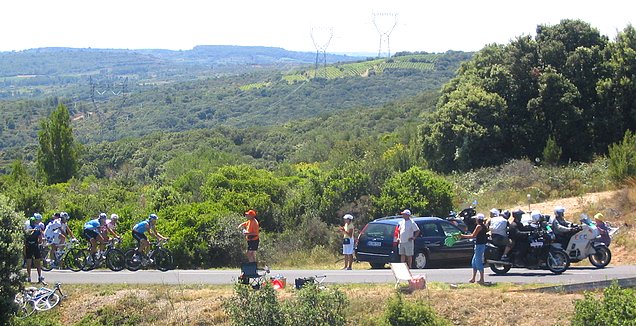
I took these shots in 2008 on the climb out of Neffies. One idea behind choosing this location was that being uphill the riders would pass by more slowly, but these things are relative and they still whizzed by.

There is more to it. As well as a great day out party atmosphere there's entertainment from the "caravan" that passes a couple of hours before the race. This stream of advertising floats throw out all sorts of gifts of varying usefulness. What also amazes is the vast number of accompanying support cars, motorbikes and vans that sandwich the riders - not to mention the helicopters.

Will Le Tour pass by next year? We'll have to wait until next May to find out.

Thursday, 25 June 2009

Scorpion

"The first scorpions of the year are in our house" declared our neighbours the other day. The nearest to chez nous I've encountered one was outside the front door where this shot was taken. It may look lobster sized, but at most it was about 5 cm long.